
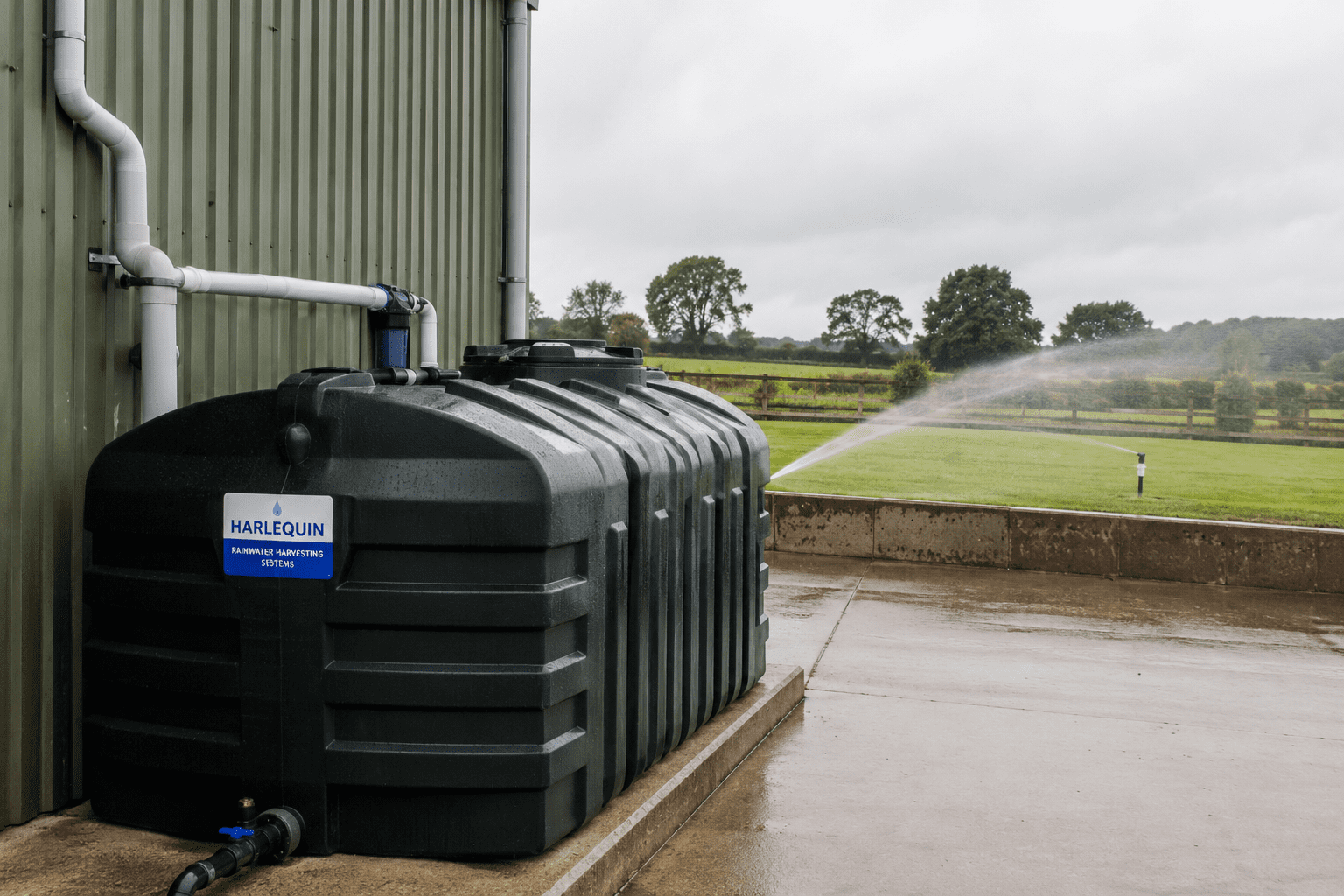
For many years, rainwater harvesting in the UK could easily have been regarded as something that was simply “nice to have”. A useful way to reduce mains water consumption, improve environmental performance and perhaps lower water bills.
The extreme weather experienced across the UK during 2026 is making that argument increasingly difficult to sustain.
Periods of exceptionally hot weather, prolonged dry conditions, falling reservoir levels and water-use restrictions have placed water conservation firmly back on the agenda for households, businesses, farms and other organisations.
At the same time, when rain does arrive, enormous quantities of water continue to fall onto roofs, enter gutters and drainage systems and simply disappear from the site.
A rainwater harvesting system provides a practical alternative.
By collecting, storing and reusing rainwater, organisations can reduce their dependence on mains water, make better use of a natural resource and build greater resilience against periods of water shortage.
At Spill Containment UK, our approach to environmental protection has always been based around controlling liquids properly. Traditionally, that means preventing oils, fuels, chemicals and other potentially harmful substances from escaping into the environment.
Rainwater harvesting approaches the same principle from the opposite direction.
Instead of containing a liquid because you do not want it to escape, you are capturing water because it is too valuable to waste.
The UK Drought of 2026 Has Changed the Conversation Around Water
The summer of 2026 has provided an uncomfortable demonstration of how quickly water availability can become an issue in the UK.
England has experienced exceptionally low rainfall alongside repeated periods of extreme heat. By August, large areas of the country were officially in drought, reservoirs were significantly below their normal levels and millions of people were affected by restrictions on water use.
For agriculture in particular, the consequences have been serious, with pressure on irrigation, crops, grass growth, livestock forage and abstraction from natural water sources.
The situation highlights an important point.
The fact that the UK receives substantial rainfall over the course of a typical year does not mean that water will necessarily be available where and when it is needed.
Rainfall can be highly seasonal and increasingly unpredictable. A property may receive thousands of litres of rainwater during wet periods, only to depend entirely on mains water or another supply during a prolonged dry spell several months later.
Rainwater harvesting allows some of that rainfall to become a usable resource rather than simply becoming surface water run-off.
What Is a Rainwater Harvesting System?
A rainwater harvesting system captures rainfall, normally from the roof of a building, before filtering and storing it in a dedicated water tank.
Depending on the system, the collected water can then be supplied when required using gravity or a pumping system.
Harvested rainwater can potentially be used for numerous non-potable applications, including:
- Landscape and garden irrigation
- Agricultural irrigation
- Crop watering
- Vehicle and machinery washing
- Yard and external cleaning
- Toilet flushing
- Grounds maintenance
- Certain industrial cleaning applications
- Livestock and agricultural applications where appropriate
- General site water requirements
The suitability of harvested rainwater for a particular application should always be assessed properly, particularly where water quality standards or human consumption are involved.
The basic principle, however, is remarkably straightforward.
Collect water when it is available and store it for when it is needed.
Why Invest in Rainwater Harvesting?
Reduce Dependence on Mains Water
Perhaps the most obvious benefit of a rainwater harvesting system is the opportunity to reduce mains water consumption.
Using treated drinking-quality water for every task on a site makes little sense when many applications do not require potable water.
Watering landscaped areas, washing equipment or cleaning yards with mains drinking water is a little like using bottled mineral water to wash a forklift. It works, but there may be a rather more sensible option available.
Harvested rainwater can replace mains water for appropriate applications, reducing demand on the public water supply.
For organisations consuming significant quantities of water, those savings can accumulate considerably over the lifetime of the system.
Reduce Water Costs
Water conservation also has a direct financial benefit.
Businesses, farms and other commercial organisations that pay for their water according to consumption can potentially reduce their bills by substituting harvested rainwater for mains water.
The financial case becomes particularly interesting for sites with two characteristics:
- A large roof collection area.
- A significant requirement for non-potable water.
Warehouses, factories, agricultural buildings, workshops, distribution centres, schools and commercial premises can all have substantial roof areas capable of capturing considerable quantities of rainfall.
Instead of allowing that water to enter the drainage system, a commercial rainwater harvesting system can turn the roof into a collection surface.
Improve Resilience During Dry Weather
The 2026 drought has also highlighted another benefit: resilience.
Rainwater harvesting cannot make it rain, nor does installing a tank guarantee unlimited water throughout a drought.
What it can do is allow an organisation to build up a stored supply during periods of rainfall.
A correctly sized system can therefore reduce reliance on mains supplies and provide additional stored water for suitable applications.
For farms and businesses where access to water is operationally important, this can form part of a broader water resilience strategy.
Support Environmental and Sustainability Objectives
Reducing mains water consumption can also contribute towards wider environmental objectives.
Businesses are increasingly being asked by customers, procurement departments, employees and supply-chain partners to demonstrate meaningful environmental improvements.
Rainwater harvesting provides a tangible measure.
Rather than simply making a general commitment to “use less water”, a business can install infrastructure that actively captures and reuses rainfall.
For organisations working towards sustainability, ESG or environmental management objectives, this provides a practical example of resource efficiency in action.
Rainwater Harvesting for Agriculture
Few sectors have a more obvious relationship with water than agriculture.
The drought conditions experienced during 2026 have placed considerable pressure on farmers, particularly where crops, irrigation and livestock depend upon reliable water availability.
Agricultural buildings can also provide excellent rainwater collection opportunities.
Barns, livestock buildings, workshops and other structures frequently have substantial roof areas. Even moderate rainfall across a large agricultural roof can produce an impressive quantity of water.
For example, 1mm of rainfall falling on 1 square metre of roof represents approximately 1 litre of water before collection losses are taken into account.
That means 10mm of rainfall falling onto a 1,000m² roof represents a theoretical 10,000 litres of water.
Suddenly, the roof of that agricultural building starts looking considerably more interesting.
An agricultural rainwater harvesting system allows farms to capture this water and store it for later use.
Depending on the operation and water-quality requirements, potential applications can include irrigation, crop watering, machinery washing, yard cleaning and other agricultural uses.
Spill Containment UK supplies agricultural systems with capacities extending into many thousands of litres, making them suitable for operations where considerably greater storage capacity is required.
Our agricultural rainwater tanks are manufactured from high-quality tank-grade virgin MDPE and rotationally moulded as a one-piece structure for strength and durability. Systems can also be interlinked where greater overall water storage capacity is required.
Selected systems incorporate filtration equipment and calmed inlets to create a practical rainwater collection and storage solution.
Commercial Rainwater Harvesting Systems
Agriculture is far from the only sector that can benefit.
Commercial and industrial buildings often have precisely the characteristics that make rainwater harvesting attractive: large roof areas combined with regular water consumption.
Potential applications include:
- Warehouses
- Manufacturing facilities
- Distribution centres
- Workshops
- Vehicle depots
- Construction and maintenance facilities
- Schools and educational sites
- Sports and leisure facilities
- Commercial estates
- Garden centres and nurseries
- Local authority facilities
- Office developments
Rainwater collected from roof areas can potentially be reused for toilets, cleaning, landscaping and other appropriate non-potable applications.
For businesses looking to reduce water consumption, a commercial rainwater harvesting system therefore represents an investment that can provide both environmental and operational benefits.
SuperComplete Rainwater Harvesting Systems
For customers requiring a more comprehensive solution, Spill Containment UK supplies SuperComplete rainwater harvesting systems designed for domestic and commercial applications.
These automatic systems are designed to collect and supply stored rainwater on demand.
Depending on capacity and specification, SuperComplete systems can include an underground MDPE rainwater storage tank, stainless steel pump, removable access lid, extended neck, in-line filter box, rainwater harvesting pipework, foot valve, connectors and isolator valve.
Selected systems use self-priming pumps capable of supplying stored water automatically when required.
Underground storage also provides an important advantage.
Rather than occupying valuable surface space with a large tank, substantial quantities of rainwater can be stored below ground while the system remains accessible for inspection and maintenance.
Spill Containment UK offers SuperComplete systems in different capacities, allowing the storage system to be matched more closely to the available roof area, anticipated rainfall and expected water demand.
Agricultural Rainwater Harvesting Systems for Larger Requirements
Where considerably larger storage capacities are required, our agricultural rainwater harvesting systems provide another option.
These systems are designed specifically for larger-scale water collection and reuse.
For example, our 20,000 litre agricultural system incorporates an industrial-strength polyethylene storage tank, rainwater filter, calmed inlet and associated connections and valves.
The tanks are manufactured in the UK from high-quality virgin MDPE using rotational moulding and carry a 10-year guarantee against manufacturing defects.
Systems can also be interconnected where still greater capacity is required.
For farms, estates and other sites with large roof areas, this provides the ability to create a substantial rainwater storage resource.
Small-Scale Rainwater Collection Still Matters
Not every application requires thousands of litres of underground storage.
Smaller buildings, workshops, gardens and locations with limited space can still benefit from collecting rainwater.
Wall-mounted water butts offer a simple way to capture rainfall from a downpipe without requiring a major installation.
These systems can be particularly useful where space is restricted or where water is required primarily for garden watering and other smaller-scale applications.
The important point is that rainwater harvesting can be scaled.
It does not have to begin with a 20,000 litre tank and an excavator arriving outside the building.
A suitable solution might range from a compact water butt through to a fully integrated commercial or agricultural rainwater harvesting system.
Rainwater Harvesting and Surface Water Management
There is another benefit that can sometimes be overlooked.
Capturing rainwater can help reduce the volume of water immediately entering surface drainage systems during rainfall.
The UK has spent much of 2026 discussing drought, but prolonged dry weather does not eliminate the possibility of intense rainfall events.
Dry conditions followed by heavy rain can create their own drainage and surface-water problems.
Rainwater storage can potentially form part of a broader water management strategy by retaining a proportion of roof run-off rather than allowing all of it to immediately enter drains.
Some larger agricultural systems can also contribute towards water attenuation strategies.
This creates an interesting environmental combination: storing water during wet conditions while creating a resource that can subsequently be used during dry periods.
How Much Rainwater Could Your Roof Collect?
The potential quantity can be surprising.
As a basic calculation:
Roof area in m² × rainfall in mm = approximate litres of rainwater falling onto the roof
So, if a commercial building has a 2,000m² roof and receives 20mm of rainfall:
2,000 × 20 = 40,000 litres
That is the theoretical volume before allowances are made for collection efficiency, filtration losses, roof characteristics and other factors.
Even after those factors are considered, large commercial and agricultural roofs can provide significant rainwater harvesting potential.
This is why system sizing matters.
Installing a tank that is too small may mean valuable rainfall is regularly lost through overflow. Installing unnecessary capacity, meanwhile, can increase the initial cost without providing sufficient additional benefit.
The best rainwater harvesting system should therefore consider both how much water can realistically be collected and how much water the site can realistically use.
Choosing the Right Rainwater Harvesting System
Several factors should be considered before selecting a system.
These include the available roof collection area, annual and seasonal rainfall, required storage capacity, expected daily water consumption, available installation space, above-ground or underground installation requirements, required pumping arrangement and the intended use of the collected water.
Commercial and agricultural projects may require considerably more planning than installing a domestic water butt.
That is precisely why choosing a system should not simply be a case of buying the largest tank available.
At Spill Containment UK, we can help customers identify an appropriate solution based on their application and required capacity.
What Does Rainwater Harvesting Have to Do With Spill Containment?
More than might initially be apparent.
Spill containment is ultimately about responsible liquid management.
A spill pallet prevents potentially harmful liquids from reaching soil, drains or watercourses. Drain protection equipment helps stop contaminants entering drainage systems. Spill kits provide a means of responding when an accidental release occurs.
Rainwater harvesting applies the same broader environmental principle to a different problem.
Water should be managed rather than wasted.
Responsible sites need to think about both sides of the equation: preventing contaminated liquids from escaping and making better use of clean water when it is available.
For industrial, agricultural and commercial organisations, environmental management increasingly means looking at the whole site rather than individual products in isolation.
Spill prevention, pollution control, drainage protection and responsible water management can all contribute towards a safer, more resilient and environmentally responsible operation.
The Drought Will Eventually End. The Water Challenge Will Not.
Britain will have wet weather again. That much is reasonably safe to predict.
The lesson from the drought and heatwaves of 2026 should not disappear the moment sustained rain returns.
Periods of extreme heat and water scarcity demonstrate the vulnerability of relying entirely on water being available whenever we turn on a tap.
At the same time, wetter periods provide an opportunity to capture and store a resource that would otherwise disappear into the drainage system.
Rainwater harvesting connects those two problems.
Capture water when it is plentiful. Store it safely. Use it when it is valuable.
For homes, businesses, farms and industrial sites, that is becoming less of an environmental novelty and more of a sensible approach to long-term water management.
Explore Rainwater Harvesting Systems from Spill Containment UK
Spill Containment UK supplies a growing range of rainwater harvesting systems for domestic, commercial and agricultural applications, from compact water collection solutions through to automatic underground systems and high-capacity agricultural rainwater storage tanks.
Whether you are looking to reduce mains water consumption, lower operating costs, improve your environmental performance or increase resilience against future periods of drought, we can help you identify a solution suited to your requirements.
Our range includes:
- Wall-mounted water butts
- SuperComplete rainwater harvesting systems
- Underground rainwater harvesting tanks
- Commercial rainwater harvesting systems
- Agricultural rainwater harvesting systems
- High-capacity rainwater storage solutions
Do not wait until the next hosepipe ban or prolonged dry spell to start thinking about the water falling onto your roof today.
Visit Spill Containment UK to explore our full range of rainwater harvesting systems, or contact our team to discuss your site, required capacity and intended application.
Reduce water waste. Reduce reliance on mains supply. Build greater water resilience.
Explore Rainwater Harvesting Systems at Spill Containment UK today.
https://www.spillcontainment.uk/rainwater-harvesting-systems-198-c.asp
Spill Containment UK
0333 090 6396